My Family Would Call Me a Terrorist If ICE Executed Me
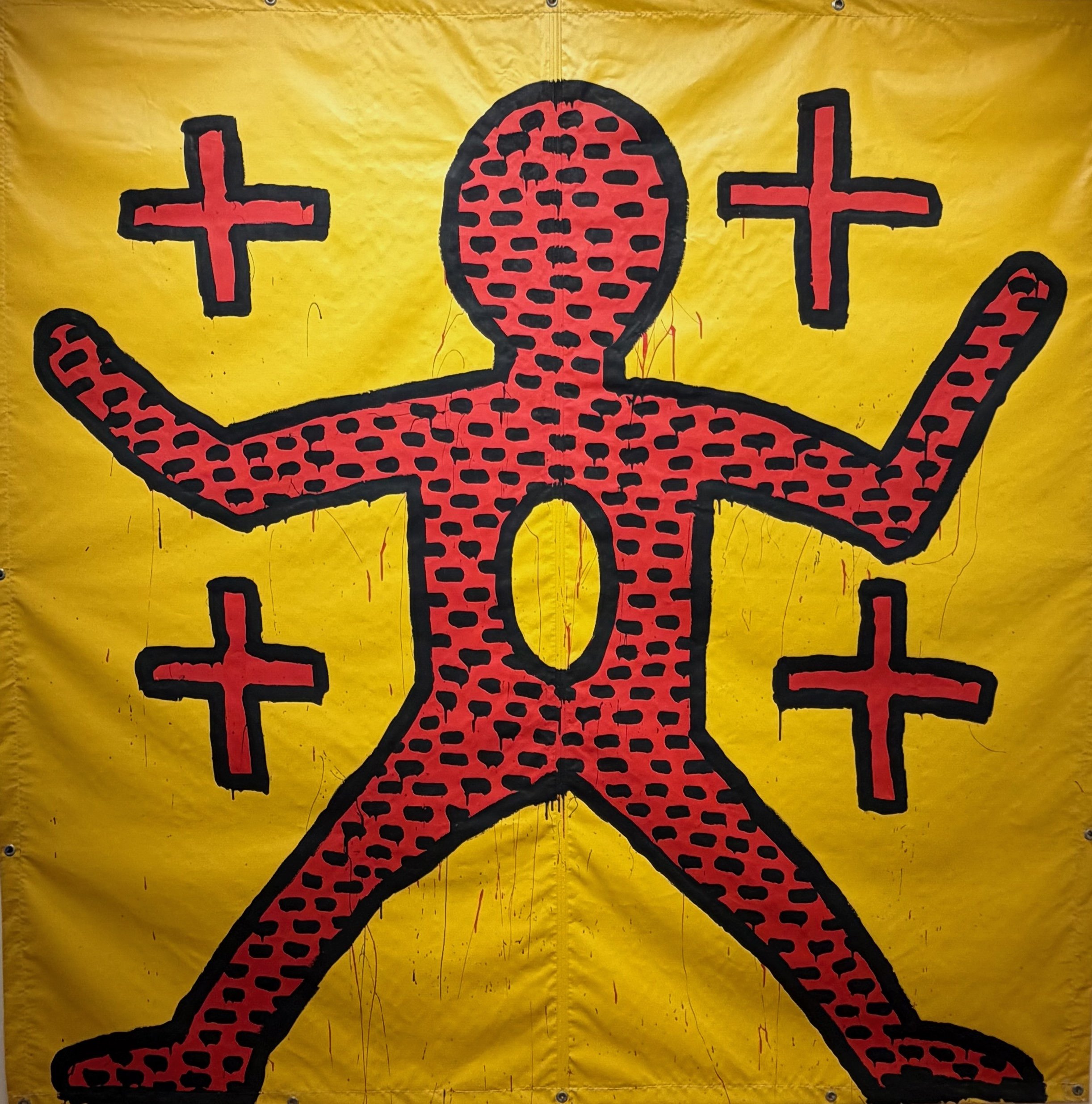
Keith Haring, Untitled, (1981)
The final line in the statement released by Alex Pretti’s parents has stayed with me. “Please get the truth out about our son. He was a good man. Thank you.” My parents would release a similar statement if ICE murdered me with impunity and called my cell phone a loaded gun. Members of my extended family, however, would believe I deserved to die.
I don’t believe this dissonance is rare or exceptional for white families. We are not suddenly viewing two different realities. This is how it has been, particularly for many non-white people. We have arrived at this moment because of a crisis of consciousness within white communities and our inability to confront ourselves seriously. It is novel for us to be killed by the state. It is not novel for our morality and our courage to die within our families. That’s not a bug, that’s the feature.
For months, maybe years now, before I go to sleep, I periodically envision my grandfather's face. I don't know how much time I have left with him on this planet. I love him deeply. I inherited so much of my personality from him. The way he speaks up when things are unjust, his keen awareness of everything going on around him. We share the same eyes and infectious smile. When I visualize his face, tears well in my eyes. Despite all he has taught me, I am unsure whether he would speak up for me. I don’t know if he would challenge the fascist forces in our community, within our own family. Would he believe what he knows about me, despite our differences, or choose to believe the lies of the state because of them?
Being explicit about those “differences” and what is behind them is important. Because they aren’t differences, they are code for something much more violent. A violence white people have been able to bypass until now because it hasn’t collectively led to our peril.
In 2024, I educated my grandfather to vote against the proposed abortion travel ban provision, but we didn’t discuss how he voted on the rest of his ticket. My mother has instructed me not to discuss politics with her family, and I oblige. I am unsure if my grandmother voted at all. Abstaining from voting has historically been her choice to opt out of the system, silently perpetuating it the way most white women do instead. My aunts and uncles continue to vote for Trump, and my grandparents voted for him in 2016 and 2020.
Before my embargo on political discussion, my “impolite disagreements” escalated into threats and physical intimidation. Outsized reactions to such “silly,” “inconsequential differences” revealed something bigger. We act shocked that the message is now comply or die, but hasn’t that always been the subtext between the “differences” amongst us? The shock is not in the forced compliance, but in the fact that the system no longer protects us and is finally turning the loaded guns on ourselves. A threat that first circulates within white families.
I comply. I don’t speak about my work or beliefs with my mom’s family. I no longer belong to them, and I don’t threaten or shame her for belonging to them. She needs her family to survive. I appease her, and this is how we are active participants in the way white power persists.
Speaking broadly about belonging as a human need means something different in a white American family. Yes, we are talking about parenthood and closeness, but we are also talking about subscription within your family unit as a subordinate, which in effect does the policing of the American state. All of the threads currently circulating about the submissiveness of conservative men who sign up to enact terror touch on the obedience we learn in our families. It is tied to Christianity or practiced on its own as a religion. Hierarchy and order, disguised in the language of love and loyalty. Both cyclically reinforce the dogma that preserves the caste of American hegemony, the state, and gendered roles. If signing up to terrorize “invaders” is what makes white men good Americans, being an obedient daughter makes white women good. Despite our “differences,” I played along.
I understood the consequences of disobedience from a young age. In the family order I grew up in, doing so meant not belonging to yourself or your family. In the white worldview, obedience to America and American values is autonomy. Protection offered to the other (which would allow white people to actually belong to ourselves and the world) is the enemy to be eradicated from within – a fidelity to the belief that people who are not white deserve less. Courage to step out of this script jeopardizes your family’s chance of gaining more power, which proves that survival amidst this self-imposed and maintained death cult is not guaranteed, even if you are white. The directive is clear: comply or die.
In a clunky, indirect way, my research on highway infrastructure and bodily autonomy is about this very topic. I was inept at speaking about my personal connection to this work. I struggled to say evident things like: “Motherhood is compulsory in Texas. Everything reinforces this down to the roads.” Another way to have said that would be, “the white American family conceals the normalization of violence. It is seen as neutral, like our highways. Now, you can’t even use them to escape or survive.”
I wanted to unpack how we got here, how I got here. But speaking honestly felt like exposing someone’s secret. It exposes our secret.
When I speak about the consensual and non-consensual aspects of my mother’s pregnancy with me, people repeatedly ask me: “Are you saying you wish your mother had aborted you? Are you not grateful to be alive?” I am the literal poster child for the American anti-abortion movement. I am proof that mothers should choose life. I have questions about the so-called life we are choosing.
Is being born into a system that murdered Alex Pretti, Renee Good, Keith Porter, George Floyd, and Philando Castile really one that values the sanctity of every life? White people do not hear and do not want to see the ways we expose our racism when we talk about children and motherhood. In the ways we speak and enforce immigration. Our actions make it so clear that we do not value life, particularly non-white life, so much so that we will kill anyone willing to interrupt our ability to enforce that system. Immigrants, pregnant mothers. I guess it’s God’s will.
When will it be enough for you to say something? When will it be enough for me to say something? Even if we don’t subscribe to this ideology, merely existing within this schism and the world it has created, and choosing only to remember the moments where we have had the choice to show up as good white people, also makes us literal terrorists—people who can uphold the system at any moment, like a loaded gun.
This propensity for understanding our violence is not new to me. My biological father is a police officer and a white nationalist. I have asked myself what it means for his blood to course through my veins. I have not, however, until this moment asked myself what it means for the rest of my white family’s to as well. The seemingly less vile, compliant, obedient blood.
Thirty years before insurrectionist Mark Lee Dickson introduced abortion travel ban legislation, my biological father used the same argument in his petition for custody of me. He accused my mother, who did not want to share custody with her abuser, of terrorism. She was trafficking his fetus. At the end of every legal document submitted to the court, he prayed that God would forgive my mother’s indiscretion. In the stories she tells, her defense attorney delivered her from evil. But everyone around her, her defense attorney included, made sure she understood that all that she and I endured was her fault simply because her body could get pregnant.
Whiteness loves a scapegoat and a witness.
My origin story exposes the power white people refuse to confront every day. My questions about that power perturb my family’s literal order and make me a terrorist. In ways that have always been more consequential within the site of my family structure than they ever will be in terms of punishment from the state, because the real risk of my life ending, even if I committed actual acts of terrorism, is less likely than the physical risk of extermination that non-white people face for simply existing. This is why Alex Pretti died protecting his neighbors.
Punishment for white people comes less from the state and more from the act of being disowned by our families, of no longer being a willing participant when faced with the loaded barrel of an ICE agent's gun, or the scorn of so-called loved ones that refuse to see you and themselves. We must see ourselves. The system manifests through our families. They are interchangeable because we can and have been evading the consequences we designed.
For my mother, losing the support of her family would mean she would lose the financial livelihood her family could provide for her if anything happened to my adoptive father, who currently supports her. This is a key feature of whiteness and an insidious feature of the idealized role of the stay-at-home mom, who is not compensated for her labor and is subservient to upholding the broader system. She is not provided equal participation in a system where women can simultaneously be both mothers and free.
I think of my grandfather’s face again, and of what I know he wanted for his daughters and granddaughters. Whether he would call me a terrorist or not is irrelevant. All I see now is the loci of white power distributed across this country, nestled within white family structures and the conversations we are not having in families like mine. I am not separate from my extended family’s politics. In separating myself, I have contributed to making the threshold for premature death higher for everyone else, including myself. And my compliance as the dutiful daughter, careful not to jeopardize her own mother’s belonging, is compliance with the state itself.